
Last Updated on October 30, 2025
You’re flat out. Invoices are going out. There’s money moving… but is your business actually profitable?
Many small business owners wonder why profit feels elusive, even when sales are steady.
For too many Australian small business owners, the answer is “I think so.” But hope isn’t a strategy.
Real business profitability doesn’t just mean staying busy—it means running a company that can sustainably pay you, fund growth, and stay cash-flow positive under pressure.
Through dozens of in-depth interviews with top-tier business coaches across Australia for The Coach Download, one theme kept coming up: most business owners aren’t checking the right numbers—and it’s hurting them.
40 percent of Australian small-medium businesses cite cash flow as their top concern.
Source: NAB Economics SME Business Insights Report, Sept 2024
As NAB notes, “Cash flow remains the biggest concern for Aussie small and medium businesses.”
Source: NAB Economics SME Business Insights Report, Sept 2024
Key Takeaways
Being busy isn’t the same as profitable
A packed schedule and plenty of invoices can still leave you underwater – tracking your daily gross profit target and job-level margins shows if your work actually pays the bills.Profit is what remains after every expense, not just direct costs
Net profit margin accounts for labour, rent, marketing, admin, tax and more – revealing the true share of each dollar you keep.You don’t need an accountant’s brain—just a simple routine
Spend 60 minutes a month on a cash-flow forecast, compare quoted vs. actual job costs, and calculate your margins to stay in control.
1 – Know Your Gross Profit Per Day
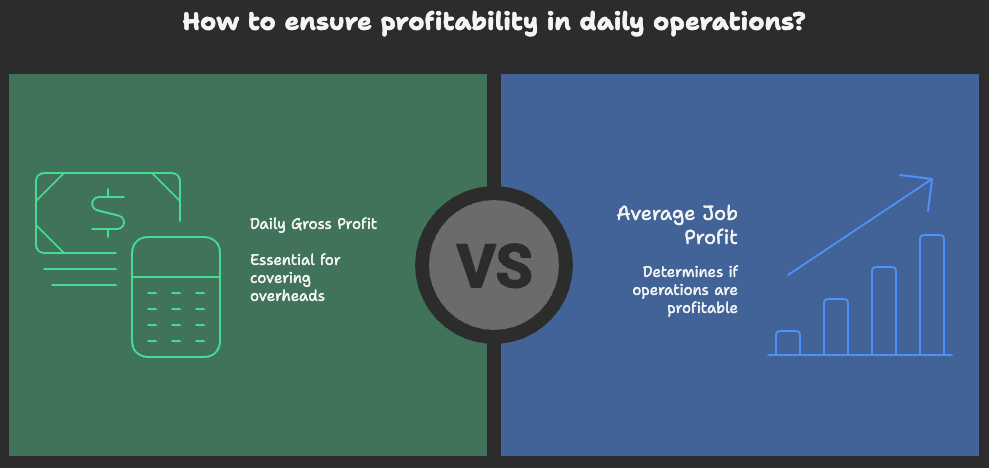
One of the fastest ways to get clear on your financial position is calculating your gross profit per day—a metric most owners never look at.
“Work out how much it costs to keep your doors open for a year. Then divide by the number of trading days per year… That’s how much gross profit you need to make just to stay in business before you make any net profit.”
— Mark Jackson, Business Coach – Business Veteran
This one number can shift your mindset immediately.
Here’s how to do it:
- Add up your total annual overheads (wages, rent, subscriptions, admin, etc.)
- Divide that number by ~250 (average trading days per year)
- That’s your daily gross profit requirement
If your average job or service isn’t hitting that number, you’re operating at a loss—even if revenue looks strong.
2 – Check Job-Level Profit (Not Just Turnover)
Do you know which of your services or projects are actually profitable? Most business owners don’t.
It’s common to have high-revenue clients or services that are barely breaking even—once you factor in admin time, rework, scope creep, or unbilled support.
Start tracking:
- Quoted hours vs. actual hours
- Fixed costs vs. time-based blowouts
- Repeat clients vs. one-off headaches
If a job costs more than it brings in—or erodes your team’s bandwidth for better work—it’s a hidden drain on your profitability.
This level of detail doesn’t require complex software. Even a simple spreadsheet can reveal where money is being made… or lost.
You need real numbers, not gut feel—here’s business coach Stirling Tavener on why running your business on instinct instead of data will stall your profitability:
3 – Review Your Net Margin (Not Just Revenue)
Revenue is a vanity metric. Profit is what pays the bills.
Your net profit margin is the percentage of revenue that’s left after everything: labour, expenses, rent, marketing, and tax.
Here’s a rough guide:
- Trades: 10–20% is strong
- Services: 20–30% is very healthy
- Below 10%? You’re on shaky ground
Typical net profit margins in Australian small services businesses range from 10 to 20 percent.
Source: CA ANZ & University of Melbourne – Small Business Profitability Report 2024
Tracking this monthly gives you an early warning system if costs start rising faster than revenue. Many owners don’t spot the issue until they hit a cash crisis.
Don’t just ask: “Are we making money?”
Ask: “What percentage of what we bring in do we keep?”

4 – Monitor Cash Flow Weekly (Not Just Monthly P&L)
Being profitable on paper means nothing if the cash isn’t there to pay suppliers, wages, or tax.
“Cash flow is an issue. Costs are going up all the time, and there doesn’t seem to be any relief… they still feel like they have a good business. They just don’t know how to take it to the next level.”
— Paul Manning, Business Coach – Profit Mentor
Cash flow management is about visibility. You need to know:
- What’s coming in (and when)
- What’s going out (and when)
- How much buffer you’ve got
Use a basic weekly cash flow forecast. Even a manual spreadsheet works if it’s updated consistently.
Businesses with a cash buffer are 46 percent more likely to withstand downturns.
Source: Xero Small Business Insights – Cash Flow Trends, Australia 2024
And remember: your bank balance is not a reflection of profitability—it’s just a snapshot in time.
It’s not just about having cash—it’s about staying focused. Listen to Cindy Drake below on how shiny-object syndrome and cash-flow chaos are killing small businesses:
5 – Set Up Monthly Financial Health Checks
Most business owners don’t have a financial rhythm. They look at reports when their accountant sends them… or when there’s a problem.
Instead, block time once a month to run a financial “health check.”
Here’s what to review:
- Gross profit vs. daily target
- Job-level profitability insights
- Net margin vs. last month
- Cash flow trends (weekly in, weekly out)
- Pricing review: when was the last increase?
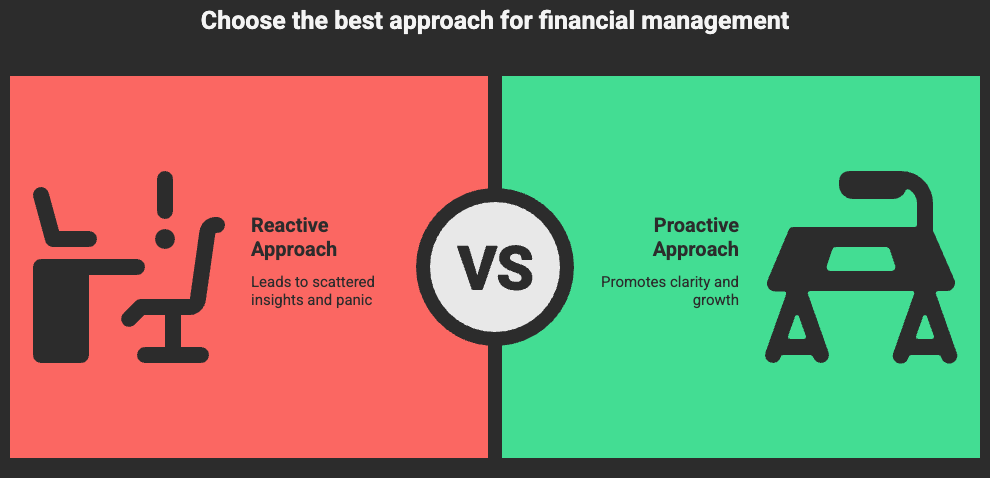
This doesn’t need to be overly complex. Simplicity and consistency beat scattered insights and end-of-year panic.
“One being is a lack of clarity over their financial performance… This means there’s a lack of growth, performance and progress of that business.”
— Stirling Tavener, Business Coach
Financial clarity isn’t optional—it’s the foundation for growth decisions that actually work.
Bonus: Build Your Profit Buffer
If your business is profitable but cash feels tight, consider building a 1–2 month overhead buffer.
This gives you breathing room in slower months, reduces stress, and gives you space to make strategic—not reactive—decisions.
Even setting aside 5–10% of each invoice into a savings account can build a meaningful buffer over time.
Conclusion: Profit Is a Discipline, Not a Feeling
You don’t need to guess whether you’re profitable. You can know.
By tracking the right numbers consistently—not just revenue or gut feel—you give yourself power to plan, adjust, and grow.
A profitable business is one that’s financially healthy, has breathing room, and can reinvest in growth without relying on luck.
Whether you’re flying blind right now or just want more control, these five steps can anchor your decision-making.
And if you want expert help reviewing your pricing, job mix, or profitability structure, Your Small Business Coach matches you with proven coaches who’ve walked this road with hundreds of business owners just like you.
Frequently Asked Questions
1. How can I tell if my business is profitable?
Track your net margin (what’s left after all costs) and compare job-level revenue vs. actual costs. Don’t just rely on revenue or gut feel.
2. Why is cash flow such a big issue if I’m profitable?
Because cash flow is about timing—when money arrives and leaves. You can be profitable and still run out of cash if invoices are delayed or costs spike.
3. What tools do I need to track business profitability?
Start with simple: a spreadsheet and 60 minutes per month. Add tools like Xero, Float, or a coach who can help set up dashboards when you’re ready to go deeper.